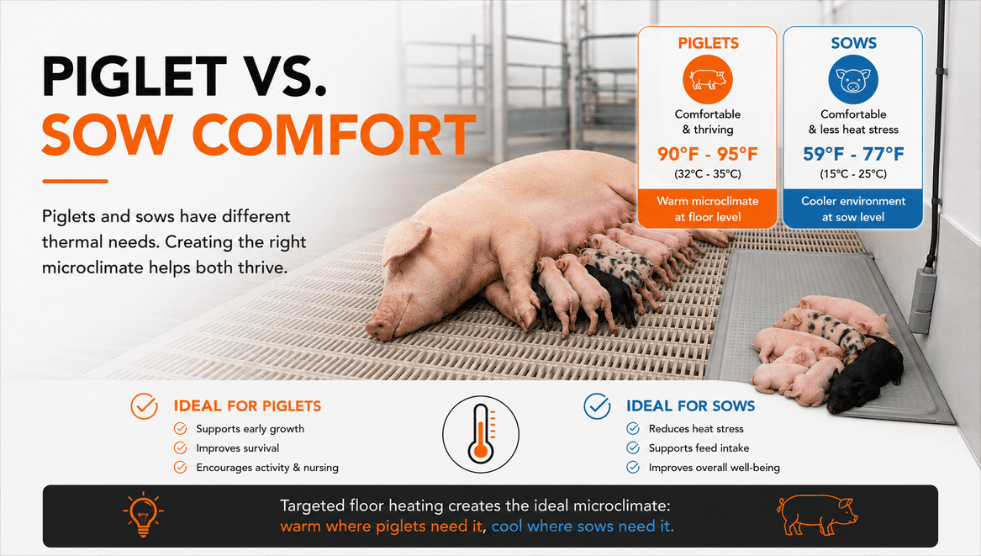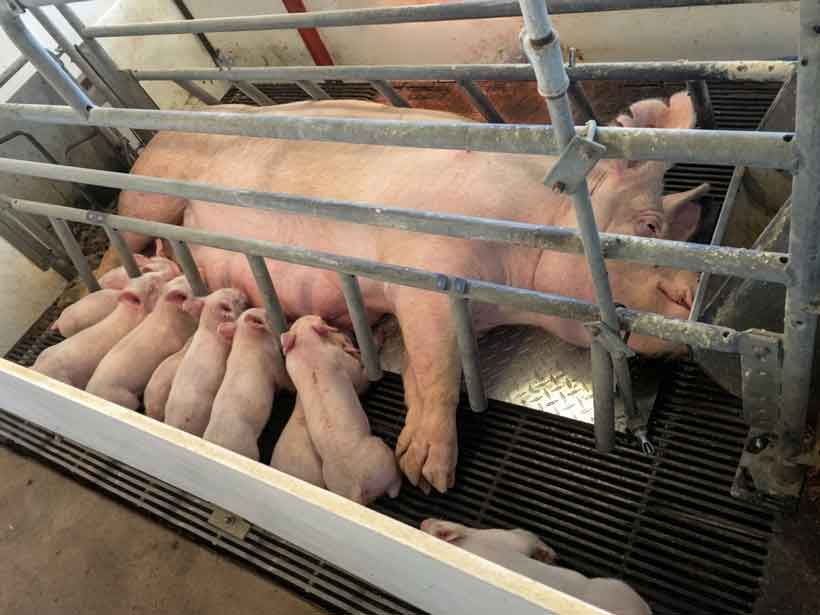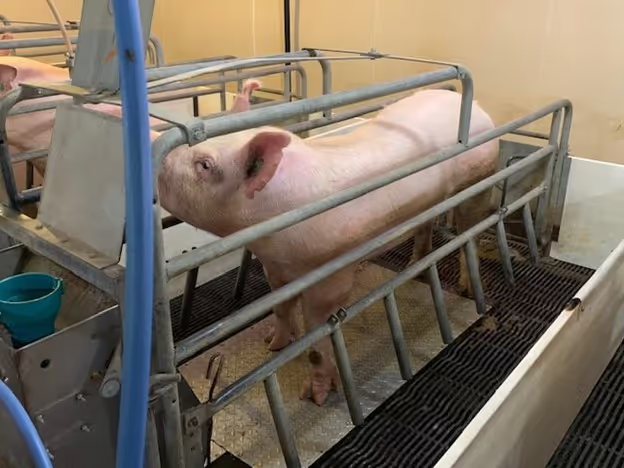
Heat stress profoundly impacts pigs across all stages of postnatal life, leading to a cascade of adverse effects that compromise lifetime health, productivity, and welfare outcomes. Clinical manifestations of heat stress include observable signs of physiological mechanisms such as increased respiration rate, open-mouth breathing, and lethargy.
In growing-finishing pigs, heat stress significantly reduces growth performance and nutrient digestibility.3 Beyond these immediate production losses, it also negatively impacts intestinal morphology and gut integrity, increasing serum oxidative markers, indicating systemic cellular stress.
Sows, particularly modern, high-producing genetic lines, are acutely susceptible to heat stress. Their larger size, leaner body composition, and intense metabolic demands from producing larger litters and more milk during lactation contribute to increased endogenous heat production. In response to high temperatures, sows attempt to combat environmental heat by reducing their feed intake, a compensatory mechanism to limit heat generated from digestion. This reduction in feed intake is accompanied by a physiological redirection of blood flow away from vital organs like the gastrointestinal tract and mammary gland towards the body’s periphery to facilitate heat dissipation. This systemic re-prioritization, however, leads to systemic inflammation, increased oxidative stress, and the development of “leaky gut,” a condition where the intestinal barrier function is compromised.
The reproductive performance of both sows and boars is significantly impaired by heat stress. In sows, heat stress reduces the quantity and quality of oocytes released before breeding, increases the occurrence of anestrus (absence of estrus), and prolongs the wean-to-estrus interval. These factors collectively lead to lower farrowing rates and reduced litter sizes in subsequent lactations. For boars, heat stress can disrupt regular estrous cycles in breeding programs, decrease libido, and severely compromise semen quality and fertility, particularly in hot and humid subtropical climates.
New research from 2025 identifies specific mechanisms for this decline, including a significant reduction in sperm mitochondrial membrane potential (MMP) and the downregulation of seminal plasma antioxidant biomarkers. These changes contribute to increased oxidative stress and lipid peroxidation within the semen, directly impairing sperm function and viability. Heat stress also affects the hypothalamus–pituitary–gonadal axis, decreasing testosterone concentration, which is critical for spermatogenesis and maintaining testicular integrity.
New research in 2025 provides a more integrated understanding of how heat stress compromises swine physiology, revealing a deeply interconnected gut-metabolic-reproductive axis. The “leaky gut,” driven by reduced blood flow, inflammation, and oxidative stress under heat stress conditions, is not merely a localized digestive impairment. Instead, it represents a systemic challenge that directly impacts nutrient utilization throughout the animal’s body and contributes significantly to overall physiological resilience. This systemic breakdown then cascades into profound reproductive dysfunction, affecting both sows and boars, as evidenced by compromised semen quality and reduced farrowing rates. This mechanistic understanding underscores the gut as a central target for comprehensive nutritional and management interventions to improve overall animal resilience and productivity under thermal challenge.
A significant and novel finding from July 2025 research highlights that early gestation heat stress (IUHS) profoundly influences fetal development and has long-term, transgenerational effects on offspring. This discovery points to a critical period for intervention that extends beyond the immediate production cycle.
The underlying mechanism involves IUHS altering the hypothalamic-pituitary-adrenal (HPA) axis development in fetuses, a central pathway for stress response. This alteration leads to increased fetal glucocorticoid exposure, specifically higher cortisol and reduced cortisone levels in the amniotic fluid. This increased fetal glucocorticoid exposure is primarily attributed to increased maternal cortisol transfer across the placenta, even when maternal salivary cortisol levels may appear similar between heat-stressed and thermoneutral gilts, suggesting complex and nuanced transfer dynamics.
The consequences of IUHS are far-reaching. It significantly reduces the total number of fetuses and viable fetuses per corpus luteum. More importantly, pigs exposed to IUHS display behaviours indicative of greater stress following standard production practices, such as transport and handling, during their postnatal life. This implies an altered lifetime behavioural and physiological stress response, making these animals inherently more reactive to stressors. Furthermore, prenatal stress has been shown to reduce the number of muscle fibres at birth, limiting the offspring’s ability to gain muscle during the fattening phase. This results in measurably slower growth rates (a reduction of 52 g/day), reduced feed intake (93 g/day less), and a final slaughter weight that is 5 kg lower compared to pigs from thermoneutral dams.
The 2025 research reveals that heat stress during early gestation is a powerful epigenetic programmer, fundamentally altering the offspring’s hypothalamic-pituitary-adrenal (HPA) axis development and stress response pathways. This “in utero programming” results in pigs that are more susceptible to stress throughout their lives and exhibit compromised growth potential and lower slaughter weights. This represents a significant, previously underappreciated, long-term economic and welfare cost for the industry. The direct impact on muscle fibre development and subsequent lower slaughter weight demonstrates how this physiological programming translates into tangible economic consequences over the animal’s entire lifetime. This necessitates a paradigm shift towards prioritizing heat stress mitigation in early gestation to safeguard not just immediate litter size but the lifetime productivity and resilience of the entire farrowed generation.
Growing-Finishing Pigs
Growth Performance, Gut Health, Antioxidant Status, Microbiome
Reduced growth performance and nutrient digestibility; adversely affected intestinal morphology, gut integrity, serum oxidative markers; improved butyric acid production; decreased Proteobacteria and Spirochaetota with LCP5 supplementation.
Gestating Sows
Feed Intake, Metabolism, Gut Health, Overall WelfareDecreased feed intake; reduced blood flow to GI tract and mammary gland; systemic inflammation; oxidative stress; “leaky gut.”
Lactating Sows
Productivity, Metabolic Heat ProductionIncreased susceptibility due to larger size, leanness, and higher productivity (larger litters, more milk); greater lactation demand and metabolic heat production.
Boars
Reproductive Performance, Semen QualityReduced libido and semen quality; lower sperm mitochondrial membrane potential (MMP); down regulation of seminal plasma antioxidant biomarkers (TAC, GPx, CAT); increased seminal plasma malondialdehyde (MDA); reduced semen volume, sperm concentration, total sperm per ejaculate, motility, viability, acrosomal integrity; higher sperm abnormalities; decreased testosterone.
Fetuses (In Utero HS)
Development, HPA Axis, Lifetime Stress Response, Growth Potential