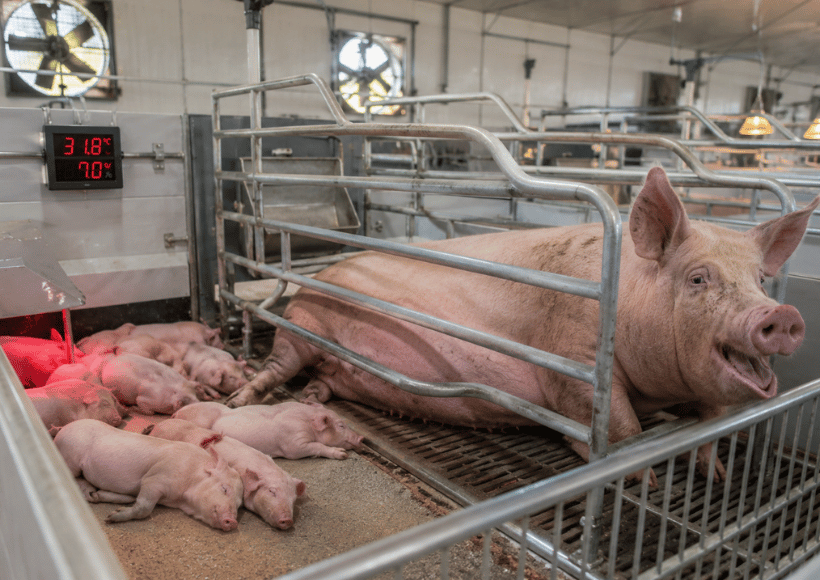
The farrowing unit represents one of the most complex and paradoxical environments in modern swine production. It is a space that must simultaneously accommodate a mature, lactating sow and her litter of newborn piglets, two groups with vastly different and often conflicting physiological needs. The central challenge lies in creating an environment that supports the health and productivity of both the heat-sensitive sow and the cold-vulnerable piglet. This fundamental conflict is a primary determinant of a farm’s economic success and is at the heart of farrowing management.
At a foundational level, the key to solving this paradox lies in a nuanced understanding of the thermoneutral zone (TNZ). The TNZ is defined as the range of ambient temperatures where an animal can maintain its core body temperature without expending additional energy for thermoregulation. When ambient temperatures fall outside this zone, either too hot or too cold, the animal is forced to divert valuable energy from growth, milk production, or reproduction to either generate or dissipate heat. This metabolic diversion leads to compromised performance, increased stress, and a cascade of negative economic consequences. A strategic, data-driven approach to environmental management in the farrowing house is not an operational expense but a high-return investment that directly addresses a significant portion of the American swine industry’s annual heat-stress-related losses, estimated at a staggering $900 million.
Newborn piglets are profoundly susceptible to cold stress due to their physiological immaturity and the shock of transitioning from a warm, 37°C sow to a cooler farrowing room. This change, combined with their wet bodies, results in significant evaporative cooling. Newborns also have a high surface area-to-volume ratio, limited energy reserves, and lack an insulating hair coat. These factors result in an exceptionally high lower critical temperature (LCT) of around 35°C, meaning they must use their limited energy to stay warm rather than on growth or finding food.
Failing to provide a warm, dry, and draft-free microclimate initiates a detrimental chain of events. A chilled piglet becomes lethargic, making it less likely to find and suckle from the sow. This failure is catastrophic in the first 24 to 48 hours of life, as the piglet requires colostrum for energy, sustenance, and crucial passive immunity. Without these antibodies, the piglet is vulnerable to pathogens and diseases like scours.
Furthermore, chilling is directly linked to mortality from crushing, which is the most significant non-infectious cause of pre-weaning death. A chilled, energy-deprived piglet instinctively seeks warmth by huddling close to the sow, placing it in a high-risk area of the farrowing pen where it can be crushed when the sow changes position
In stark contrast to her piglets, the lactating sow is highly susceptible to heat stress and requires a cool environment to maintain her productivity. A sow’s large body mass, high metabolic heat production during lactation, and the physiological inability to sweat make her particularly vulnerable to overheating. Her ideal TNZ is substantially lower than a piglet’s, with an optimal range of 15 to 20°C (59 to 68°F). Temperatures rising above 22°C (72°F) can induce significant heat stress.
When a sow experiences heat stress, her primary physiological response is to reduce her Voluntary Feed Intake (VFI) to lower the metabolic heat generated by digestion. This reduction in feed consumption is directly proportional to the temperature increase, with VFI declining by an estimated 170g per day for every 1°C rise in temperature above 16°C. This decrease in feed intake has severe, cascading consequences: it compromises milk production, which directly impacts piglet growth and survival rates. Furthermore, reduced VFI leads to poor body condition at the time of weaning. Sows that lose significant weight during lactation may experience a longer wean-to-estrus interval and decreased conception rates in subsequent breeding cycles, affecting overall herd reproductive efficiency. Prolonged heat stress can also lead to increased stillbirths and, in extreme cases, higher sow mortality.
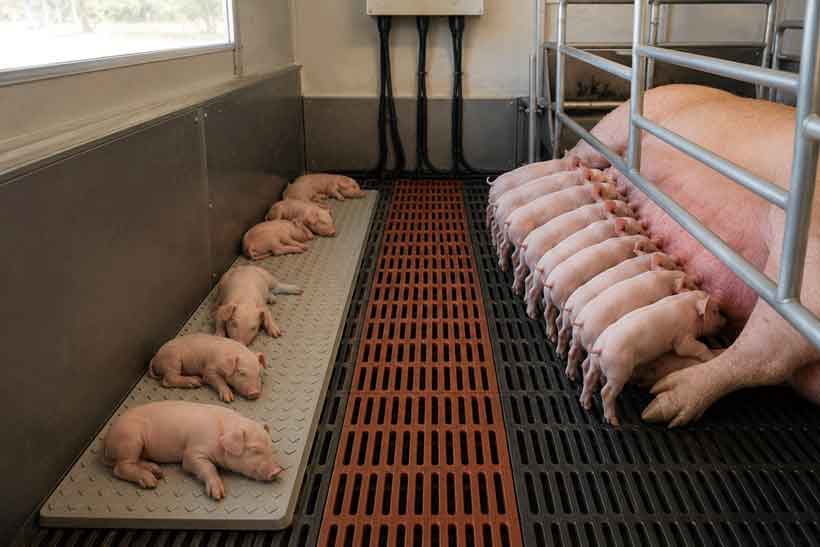
The farrowing house paradox, where the sow needs to be cool and the piglets need to be warm, cannot be solved by compromising on a single room temperature. A moderate temperature that is too warm for the sow and too cold for the piglets will compromise the health and productivity of both. The most effective solution is the principle of zonal heating, which involves strategically creating a microclimate that provides a targeted, warm area for the piglets while allowing the rest of the farrowing room to remain at a cooler, more comfortable temperature for the sow.
The core concept is to use a radiant or conductive heat source to create a “safe zone” or “creep area” for the piglets. This microclimate, with a temperature of 30-35°C, effectively attracts the piglets away from the sow, providing them with the necessary warmth and, in doing so, significantly reducing the risk of crushing. By keeping the sow comfortable at a room temperature of 18-20°C, her feed intake and milk production remain optimized, ensuring she can effectively nurse a large litter without compromising her own health or future reproductive performance.
A crucial consideration when designing a modern farrowing system is that the challenge of thermal management is not static; it is, in fact, intensifying. Older ventilation and heating standards were based on sows that weighed less (200-250 kg) and produced smaller litters (averaging 10 live-born piglets). Today, genetic selection for productivity has resulted in sows that are significantly heavier (up to 300 kg) and produce much larger litters (easily 18 live-born piglets). The increased productivity of these animals results in a greater metabolic heat load. Therefore, the total heat produced in a farrowing house is substantially higher than in previous generations. Many existing facilities may be operating with outdated calculations, a problem that justifies a proactive re-evaluation of farm infrastructure and an investment in modern, high-efficiency systems.
Heat lamps have long been a traditional method for providing supplemental heat to piglets. These systems provide top-down radiant heat, a common and relatively low-cost initial investment. However, their widespread use comes with several significant drawbacks. Heat lamps are inherently energy-inefficient, with a high wattage that typically ranges from 175W to 250W per crate. The top-down heating method means that a significant portion of the heat rises and is not effectively utilized by the piglets. To compensate and provide a larger heated area, lamps must be raised, which in turn decreases the intensity and effectiveness of the heat.
Beyond their inefficiency, heat lamps pose notable safety and maintenance risks. The bulbs can overheat or break, presenting a potential fire hazard and a risk of injury to both animals and staff. Their short lifespan, which can be as little as a few days, necessitates frequent and costly replacements, increasing labour and maintenance expenses. In terms of animal welfare, heat lamps can be counterproductive, as the radiant heat can warm the sow, making her uncomfortable and encouraging her to move. Simultaneously, the heat source may encourage piglets to lie dangerously close to her for warmth, leading to increased crush losses.
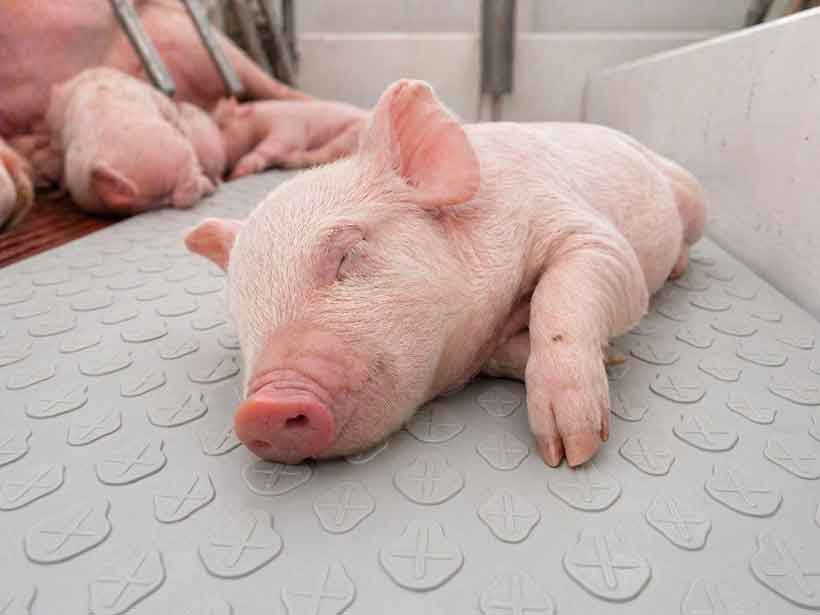
Electric heat mats represent a modern and highly efficient alternative to heat lamps. These mats provide bottom-up heat via conduction, a method that is more practical and economical because the heat rises and is directly transferred to the piglet’s body. Heat mats are significantly more energy-efficient, with a much lower wattage of 60W to 100W per crate. This lower consumption translates to substantial energy savings, ranging from 40% to 80% compared to heat lamps.
The use of heat mats leads to measurable improvements in both animal welfare and productivity. By creating a safe, warm, and uniform heated zone away from the sow, heat mats actively encourage piglets to rest in a protected area, reducing the risk of crushing. Research has validated that this approach can reduce pre-weaning mortality, resulting in an increase of 0.5 pigs per litter. Furthermore, heat mats are highly durable, with a lifespan of years rather than days. Their solid, easy-to-clean surface minimizes the risk of bacterial buildup, helping to reduce disease concerns.
The economic impact of pre-weaning piglet mortality is one of the most significant challenges in swine production. Pre-weaning mortality rates range from 10% to 20%, representing a direct loss of marketable product and a major drag on farm productivity. A single sow’s death can cost a farm approximately USD1,200, factoring in the sow’s value and the lost production of her litter.
Investment in proper thermal management directly combats these losses by improving piglet survival. Research has documented that using heat mats, for instance, can lead to an increase of 0.5 pigs per litter. While this number may seem small, its cumulative effect is dramatic. For a farm with 14 litters per sow per year, this translates to an additional seven marketable pigs annually per sow. When multiplied across an entire herd, the financial benefit far outweighs the initial investment in modern heating equipment.
The economic argument for climate control extends far beyond the direct savings from reduced energy consumption. Heat mats can reduce energy usage by up to 65% compared to lamps, making them the most compelling financial benefit and the positive effects on animal performance.
By creating a cooler environment for the sow, her feed intake increases. This higher VFI leads to increased milk production and, as a result, heavier and faster-growing piglets at weaning. Simultaneously, the heated microclimate for the piglets reduces cold stress, a primary cause of mortality from crushing. A single investment in a technology like a Hog Hearth heat mat, therefore, delivers a triple benefit: direct energy savings, increased productivity from higher piglet survival and growth, and improved sow health and reproductive performance for the next cycle. The payback period for a heat mat system is routinely within 14 months to a little over a year, demonstrating a rapid and exceptional return on investment.
The core economic benefit is not the utility bill reduction but the compounded value of increased animal performance and survival. Energy savings are an important part of the equation, but the true profitability lies in the ability to produce a higher number of healthier, more valuable pigs.
The farrowing unit’s thermal environment is a critical determinant of a swine operation’s profitability and sustainability. The fundamental conflict between the sow’s need for a cool environment and the piglet’s need for warmth can only be resolved through a strategic approach to zonal heating and holistic environmental management.